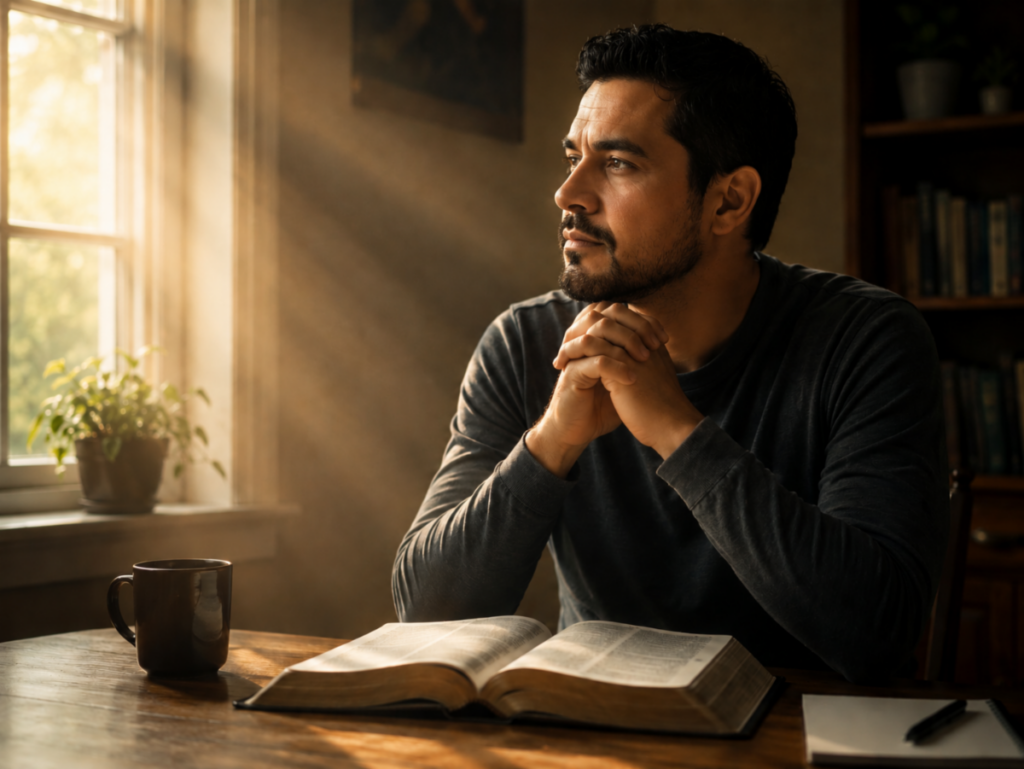
If you’ve ever thought about praying and immediately wondered how to do it or weren’t sure how to start, you’re in better company than you might think. Prayer is one of the most searched Bible study topics in all of Scripture, and also one of the most misunderstood. Many people picture it as something that requires a quiet room, the right words, or a level of faith they haven’t reached yet.
The Bible paints a very different picture. According to Scripture, prayer is simply honest conversation with God. Not a performance, not a ritual, and not something reserved for people who already have their lives together. Just a person bringing their real thoughts, needs, and questions to a God who already knows them and genuinely wants to hear from them.
What Does the Bible Say About How to Pray?
Jesus addresses this directly in Matthew 6, and what He says might surprise people who picture prayer as formal or complicated. He actually cautions against long, impressive-sounding prayers and instead encourages something closer to a private conversation: sincere, humble, and personal. The Model Prayer that Jesus gave isn’t a script so much as a pattern. Acknowledge who God is. Ask for what you need. Seek forgiveness. Trust His lead.
The book of Psalms offers a different window into prayer. These 150 chapters are essentially an ancient prayer journal, covering every emotional experience imaginable: grief, anger, gratitude, confusion, and hope. If the Psalms tell us anything, it’s that God welcomes honesty far more than eloquence.
Does the Bible Say God Actually Hears Our Prayers?
This is the deeper question most people are really asking when they want to know what does the Bible say about prayer. Does it reach anyone? Does it do anything?
Scripture is consistent on this. Jeremiah 33:3 records God saying, “Call to me and I will answer you.” 1 John 5:14 says that when we ask according to His will, He hears us. James 5:16 describes the prayer of a righteous person as “powerful and effective.” The picture throughout the Bible is not of a distant God who tolerates our questions, but one who actively invites them.
That said, Scripture is also honest that God’s answers don’t always arrive the way we expect, or on our timeline. Prayer is not a wish list, and the Bible doesn’t frame it as one. What it does consistently offer is an open invitation to bring our needs, our fears, our gratitude, and our confusion to God, with no prerequisites attached.
What Are Some Biblical Principles for Prayer?
Beyond the bigger questions of what and why, Scripture gives us some practical principles for how to approach prayer:
- Be honest. God already knows your situation. You don’t have to clean it up before bringing it to Him.
- Be persistent. In Luke 18, Jesus tells a parable specifically to encourage people not to give up on prayer, even when answers seem slow.
- Give thanks. Philippians 4:6 pairs prayer with thanksgiving, suggesting that even a small measure of gratitude can shift the tone of the whole conversation.
- Pray for others. James 5:16 frames prayer as something we do together as well as alone, making it a communal act and not only a private one.
For anyone exploring these Bible study topics for the first time, prayer is one of the most natural starting points. It asks nothing of you except a willingness to show up as you are.
Where Do You Start If You’ve Never Prayed Before?
Start simple. Start honest. There is no required language, no required posture, and no minimum length. If you want a framework, the Model Prayer that Jesus gave in Matthew 6 is a good place to begin, not as a recitation, but as a shape for your own thoughts.
Many people also find that understanding what the Bible says about who God is, what Jesus taught, and how others have followed Him gives prayer more context and meaning. Learning who you’re talking to matters.
At the Palm Beach Lakes church of Christ in Palm Beach Gardens, we welcome people at every stage of this conversation, whether you’ve prayed your whole life or you’re just now considering it for the first time. If you’d like to explore prayer or any other part of Scripture alongside others who are on the same journey, we’d love to hear from you.